Why Titanium Is Used in Long-Endurance UAV Structures
Author:BOZE CNC Ti Engineering Team
Time:2026-05-20
View:229
Long-endurance UAV airframes fail for reasons that rarely appear in specification sheets. Vibration accumulates silently across thousands of flight hours. Corrosion advances in maritime and high-humidity environments where inspection intervals are measured in months, not days. Under these conditions, the material choice is not a performance optimization — it is a structural reliability decision. Titanium, specifically Ti-6Al-4V for primary load paths and Grade 2 for corrosion-critical geometries, addresses a set of compounding engineering constraints that aluminum and composite solutions manage less predictably across extended service life. This document examines each constraint in sequence, explains the material tradeoffs honestly, and addresses the manufacturing realities that procurement teams frequently underestimate.

Contents
The Real Engineering Challenge Behind Long-Endurance UAVs
Constraint 1 — Repeated Vibration Exposure During Long Flight Hours
Constraint 2 — Corrosion Risk in Maritime and Remote Environments
Constraint 3 — Structural Stability in Lightweight Airframes
Constraint 4 — Reliability Under Reduced Maintenance Cycles
Constraint 5 — High-Cycle Load Stress Around Critical Interfaces
The Manufacturing Reality Behind Titanium UAV Structures
Why Manufacturing Control Matters for UAV Titanium Components
The Real Engineering Challenge Behind Long-Endurance UAVs
Most discussions of UAV airframe design begin with weight reduction. That framing obscures the actual problem. Weight savings that introduce long-term fatigue vulnerability, corrosion susceptibility, or dimensional instability do not serve endurance-mission requirements — they simply defer structural failure to a point in the service life where recovery is more difficult and costly.
Long-endurance UAV operations impose four simultaneous environmental stresses on the airframe structure: continuous low-amplitude vibration from propulsion and aerodynamic turbulence, cyclic loading at wing roots and attachment interfaces during climb-cruise-descent cycles, exposure to humidity and corrosive atmospheric chemistry in maritime patrol and remote monitoring applications, and extended intervals between ground inspection and maintenance. None of these stresses is catastrophic in isolation. Their compounding interaction over thousands of flight hours is where most material selection decisions are actually tested.
An airframe material well-suited to a 200-hour tactical UAV does not necessarily perform reliably in a platform expected to accumulate 5,000 hours over five years of operational deployment. The performance envelope that matters is not peak load capacity — it is structural integrity across the entire operational lifespan under realistic environmental exposure.
The fatigue behavior of an airframe material at 500 hours provides limited guidance about its behavior at 3,000 hours under combined vibration and corrosion exposure. Endurance UAV procurement decisions that rely on short-duration test data carry structural risk that typically surfaces late in the platform's service life.
This is the engineering environment in which titanium becomes relevant. Not because it is the lightest option, and not because it is the strongest — but because it maintains structural predictability across the combined stress profile that long-endurance missions produce.
Constraint 1 — Repeated Vibration Exposure During Long Flight Hours
Vibration is not a single event in UAV operations — it is a continuous background condition that accumulates structural consequence across every flight hour. Propulsion-induced vibration, airframe resonance during turbulence, and aerodynamic buffeting at control surfaces create a sustained cycle of micro-stress at joints, fastener holes, and thin-wall panels. In short-duration platforms, this accumulation is managed through scheduled inspection and periodic fastener torque verification. In long-endurance deployments, the total cycle count reaches thresholds where material fatigue behavior — not peak tensile strength — determines structural outcome.
Titanium's fatigue limit under high-cycle loading is proportionally higher relative to its density than aluminum alloys used in comparable airframe applications. For airframes accumulating sustained vibration across thousands of flight hours, this characteristic reduces the probability of progressive fatigue cracking at stress concentrations — particularly at fastener holes and welded or bonded interfaces.
The underlying mechanism is not mysterious. Aluminum alloys used in aerospace structures — including 7075-T6, which appears in many UAV primary structures — do not exhibit a well-defined fatigue limit under high-cycle conditions. Fatigue strength continues to decline with increasing cycle count. Titanium alloys, by contrast, approach a stabilized fatigue threshold at high cycle counts under controlled amplitude loading. In environments where vibration amplitude is predictable and sustained — as is typical of fixed-wing endurance UAVs during cruise — this distinction affects long-term structural reliability in ways that initial material testing does not always reveal.
Advocates for aluminum airframes correctly note that modern aerospace-grade aluminum alloys offer excellent strength-to-weight ratios and are far more easily machined than titanium. That argument is valid for platforms with defined, short service lives and accessible inspection intervals. It becomes structurally questionable when the operational scenario involves cumulative flight hours well beyond what periodic inspection can realistically monitor — which describes most long-endurance UAV deployment contexts accurately.
UAVs are particularly vulnerable to vibration fatigue accumulation because their propulsion systems operate at relatively fixed throttle settings during cruise, producing a narrow frequency band of continuous excitation. Unlike manned aircraft that vary power settings and altitude frequently, endurance UAVs often maintain cruise conditions for hours at a time, concentrating fatigue cycles at specific structural resonance points. This is precisely where titanium's fatigue stability provides operational value that weight comparisons alone do not capture.
| Material | High-Cycle Fatigue Behavior | Vibration Damping | Endurance Implication |
|---|---|---|---|
| Ti-6Al-4V (AMS 4928) | Approaches stabilized fatigue threshold at high cycle counts under controlled amplitude | Moderate — generally superior to aluminum alloys at equivalent section thickness | Predictable fatigue behavior across extended service life; relevant for 3,000+ hour deployments |
| 7075-T6 Aluminum | No defined fatigue limit; strength continues to decline with cycle count | Lower than titanium at equivalent geometry | Requires tighter inspection intervals to manage cumulative fatigue risk over long deployments |
| Carbon Fiber Composite (CFRP) | High fatigue resistance in fiber direction; delamination risk at joints and fastener holes | High in-plane damping; poor at interfaces | Fatigue behavior at attachment interfaces and fastener holes requires careful joint design and inspection access |
| Grade 2 Titanium (ASTM B265) | Lower strength than Ti-6Al-4V; adequate for non-primary structural applications | Similar to Ti-6Al-4V | Appropriate for corrosion-sensitive secondary structures; not recommended for primary high-load paths |
Note: Fatigue behavior is application-dependent. Values reflect general engineering guidance under representative endurance UAV loading conditions. Structural analysis for specific platforms should reference applicable AMS and ASTM material specifications.
Constraint 2 — Corrosion Risk in Maritime and Remote Environments
Long-endurance UAV deployment scenarios frequently involve maritime patrol, coastal surveillance, and remote area monitoring — environments characterized by salt fog, elevated humidity, and limited access to conventional maintenance facilities. Corrosion risk in these contexts differs significantly from the controlled atmospheric conditions assumed by standard military and civil corrosion protection specifications.
Salt fog exposure degrades aluminum alloy structures through two primary mechanisms: general surface corrosion that removes protective anodizing over time, and intergranular corrosion that penetrates grain boundaries in high-strength alloys like 7075. The second mechanism is operationally dangerous because it develops internally, is invisible during surface inspection, and can progress significantly before detection. Protective coating systems mitigate this risk in maintained platforms, but in remote deployments where the maintenance interval may be three to six months, coating degradation at fastener holes, lap joints, and structural edges creates exposure windows that extend beyond design assumptions.
Titanium forms a stable, self-repairing oxide layer — TiO₂ — when exposed to oxygen, including the oxygen dissolved in salt water and humid air. This passivation layer regenerates automatically when surface damage occurs. The practical consequence in maritime deployment is that titanium structural components do not require the same active corrosion management regimen as aluminum equivalents. The protection is intrinsic rather than applied.
This distinction has direct procurement and operational implications. Aluminum airframes in maritime environments require more rigorous protective coatings, more frequent inspection of coating integrity, and more careful attention to galvanic compatibility at titanium-aluminum or steel-aluminum interfaces. These requirements are manageable in bases with maintenance personnel and controlled environments. In remote deployments — autonomous weather stations, maritime patrol in locations without ground support infrastructure — they create structural risk gaps that titanium passivation behavior largely eliminates.
Aluminum airframes in maritime service may carry lower material acquisition costs than equivalent titanium structures, but the full life-cycle cost comparison requires including protective coating application, inspection frequency, coating repair between deployments, and the cost of corrosion-related structural repairs or component replacement over a five- to ten-year operational life. When these factors are included, the titanium premium often narrows substantially — particularly for platforms deployed in high-humidity coastal environments.
Galvanic Compatibility in Mixed-Material Airframes
Endurance UAV structures typically combine multiple materials — carbon fiber composites for aerodynamic surfaces, titanium for primary load-bearing structural members, and aluminum for non-structural brackets and housings. Galvanic compatibility at these material interfaces requires careful engineering attention. Carbon fiber is cathodic relative to both aluminum and titanium; direct contact between CFRP and aluminum alloy in a humid environment accelerates aluminum corrosion at the interface. Titanium is significantly more electrochemically compatible with carbon fiber than aluminum is, which simplifies the joint design requirements in mixed-material structures and reduces the long-term corrosion management burden at composite-to-metal interfaces.
Constraint 3 — Structural Stability in Lightweight Airframes
The requirement to minimize airframe weight in endurance UAVs creates a structural geometry problem: as section thicknesses decrease and component geometries become more complex, the margin between adequate structural stiffness and failure-prone flexibility narrows. Thin-wall panels, slender spar sections, and lightly built attachment brackets are necessary for weight targets — but they amplify the consequences of any degradation in material stiffness or dimensional stability over the service life.
Titanium's specific strength — the ratio of yield strength to density — allows designers to achieve required load-carrying capacity at lower section thicknesses than equivalent aluminum structures. For endurance UAV primary structures, this means that stiffness requirements and weight targets can be reconciled without the wall thickness penalties that constrain aluminum design in some structural configurations.
The stiffness retention characteristic is equally relevant. Aluminum alloys exhibit relatively linear elastic behavior under static loading, but their effective stiffness in dynamic loading conditions — particularly in thin-wall sections subject to combined bending and torsion — can be influenced by cumulative microstructural changes over long fatigue exposure. Titanium alloys maintain dimensional and stiffness characteristics more consistently across extended loading cycles, which is relevant for the geometric tolerances that wing attachment fittings and control surface hinges must maintain over years of operation.
Fatigue-sensitive joints present a specific geometry challenge in UAV structural design. Wing root attach fittings, fuselage frame intersections, and propulsion mount pads must be both structurally adequate and manufacturable within tight weight budgets. These are precisely the locations where titanium's combination of high fatigue resistance and specific strength provides the most concentrated design benefit — allowing joint geometries that satisfy structural requirements without the weight penalty that equivalent aluminum designs would carry.
| Property | Ti-6Al-4V (AMS 4928) | 7075-T6 Aluminum | Engineering Implication |
|---|---|---|---|
| Typical Yield Strength | ~880 MPa | ~503 MPa | Ti-6Al-4V carries higher load per unit cross-section |
| Density | ~4.43 g/cm³ | ~2.81 g/cm³ | Aluminum is lighter per volume; titanium is superior per unit strength |
| Specific Strength (approx.) | ~199 kNm/kg | ~179 kNm/kg | Titanium allows thinner sections at equivalent load capacity |
| Elastic Modulus | ~114 GPa | ~71.7 GPa | Titanium stiffer per cross-section; aluminum requires larger sections for equivalent stiffness |
| Fatigue Limit Ratio | ~0.50–0.60 of UTS | No defined limit; continues declining | Critical difference for high-cycle endurance applications |
Note: Representative engineering values based on standard aerospace material references (AMS 4928, ASTM B209). Actual component design values depend on specific heat treatment condition, surface finish, and safety factor requirements per applicable design standard.
Constraint 4 — Reliability Under Reduced Maintenance Cycles
Long-endurance UAV platforms are frequently deployed in operational scenarios that preclude normal maintenance access — extended maritime patrol, persistent ISR operations over remote terrain, or multi-month deployments at austere forward locations. The maintenance intervals that a normal aviation maintenance program assumes — regular visual inspection, torque check of fasteners, corrosion treatment of affected areas — may be compressed, delayed, or simply not achievable in these contexts.
The structural material choice is therefore not just a performance decision. It is a risk management decision about how much the airframe can tolerate deferred maintenance without accumulating undetected structural degradation.
An airframe that requires diligent corrosion management to maintain its structural integrity is a maintenance-dependent system. Deployed in environments where maintenance discipline cannot be guaranteed, it carries hidden structural risk. Titanium's corrosion passivation behavior converts a maintenance-dependent protection system into an intrinsic material property — one that does not degrade between inspection cycles.
The same logic applies to fatigue accumulation. An aluminum structure that requires periodic non-destructive inspection of fatigue-critical joints to remain airworthy imposes an inspection burden on operational programs. Titanium structures in equivalent applications typically allow longer intervals between fatigue-critical inspections, not because fatigue does not occur, but because the material's fatigue behavior is more predictable and the threshold for progressive crack initiation is higher relative to the operating stress levels in endurance UAV applications.
Remote deployment also creates a parts availability constraint that material selection affects. When a titanium structural component requires replacement, sourcing a certified replacement part in a remote location may take days or weeks. This is a valid operational concern. It argues for designing titanium components with sufficient fatigue margin that replacement is driven by scheduled intervals rather than unanticipated damage — which reinforces the case for adequate material selection at initial design rather than compensating with higher maintenance frequency later.
| Factor | Titanium Structures | Aluminum Structures | Operational Risk if Deferred |
|---|---|---|---|
| Corrosion Management | Passive — TiO₂ layer self-repairs; no active treatment required | Active — requires coating integrity maintenance; galvanic protection at interfaces | Aluminum: intergranular corrosion risk develops if coatings degrade undetected |
| Fatigue Inspection Interval | Longer intervals typically acceptable for primary structure under normal endurance loading | Shorter intervals required; no defined fatigue limit in high-strength alloys | Aluminum: progressive fatigue cracking possible at fastener holes and load-path joints |
| Joint Dimensional Stability | High — titanium maintains dimensional tolerances across wide temperature range | Moderate — thermal expansion higher; dimensional stability at joints requires fastener preload monitoring | Both: fastener loosening under thermal cycling if preload not maintained |
| Surface Damage Sensitivity | Lower — surface scratches do not initiate corrosion chain reaction | Higher — coating damage exposes substrate; handling damage accelerates corrosion in humid environments | Aluminum: surface handling damage in field conditions introduces corrosion initiation sites |
Note: Risk levels reflect general material behavior under representative remote deployment conditions. Specific platform risk assessment requires platform-specific fatigue analysis and inspection program development.
Constraint 5 — High-Cycle Load Stress Around Critical Interfaces
The structural interfaces that fail first in long-endurance UAV airframes are not the large primary sections — they are the local stress concentrations at propulsion mounts, wing-fuselage attachments, landing gear interfaces, and control surface hinge lines. These locations combine high local stress with geometric stress concentration factors, cyclically applied loads, and in some cases, thermally induced stress from proximity to propulsion systems. They accumulate fatigue damage faster than surrounding structure, and they are typically the locations where material selection decisions have the most concentrated structural consequence.
Propulsion Mount Interfaces
Fixed-wing endurance UAVs with combustion or turbine propulsion transmit substantial vibration into the airframe at the engine mount attachment points. These loads are continuous during cruise, directional, and occur at frequencies determined by propulsion system characteristics rather than airframe structural response. The resulting fatigue environment at mount attach fittings is demanding — the local stress amplitudes may be modest compared to gust or maneuver loads, but the cycle count over a 5,000-hour service life reaches values where aluminum alloy fatigue behavior without a defined endurance limit becomes a structural liability.
Propulsion mount fittings machined from Ti-6Al-4V that are properly designed for fatigue — with adequate fillet radii at stress concentrations, appropriate surface finish in fatigue-critical areas, and correct fastener hole preparation — can accumulate high cycle counts at typical endurance UAV propulsion vibration amplitudes with lower risk of progressive fatigue cracking than equivalent aluminum fittings. This is not a theoretical advantage; it affects inspection interval decisions and structural life management programs.
Wing Attachment and Spar Carry-Through
Wing root attachments experience the highest bending moment transfer loads in fixed-wing UAV structures during maneuver and gust events, superimposed on a background of lower-amplitude vibration-induced cycling during cruise. The combination of high peak stress during discrete events and high-cycle background loading is the most demanding fatigue scenario in the airframe. For platforms with intended service lives exceeding 3,000 hours, this load combination generally argues for titanium alloy at spar carry-through fittings and main attach lugs — not because aluminum cannot be designed to adequate static strength, but because the cumulative high-cycle fatigue exposure over the service life creates structural uncertainty that titanium's fatigue characteristics reduce.
Landing Interface Loads
Runway or semi-prepared surface landings impose ground-transmitted shock loads through landing gear attachment structure that, while brief, accumulate over the total number of flight cycles across the platform's life. For UAV platforms expected to complete many hundreds or thousands of sorties, landing gear attach fittings represent a fatigue-sensitive location where titanium's combination of high specific strength and fatigue resistance provides design flexibility — particularly where geometry constraints limit the available section area for the attachment structure.
Carbon fiber composites offer high specific strength and excellent in-plane fatigue resistance. They are genuinely appropriate for aerodynamic surfaces, secondary panels, and non-fastened primary structure. At bolted or pinned interfaces — attach lugs, hinge fittings, fastener-intensive joints — bearing stress limits and through-thickness strength characteristics of laminates impose design constraints that frequently result in local titanium metallic inserts or titanium fitting elements even in otherwise composite-primary structures. A purely composite solution at high-load attach interfaces is structurally possible but mechanically demanding and dimensionally sensitive to manufacturing variation in ways that titanium fittings are not.
The Manufacturing Reality Behind Titanium UAV Structures
The structural arguments for titanium in long-endurance UAV applications are well-supported. The manufacturing arguments introduce a different set of challenges that procurement teams should understand before assuming that structural material selection directly translates into supplier selection.
Titanium's low thermal conductivity — approximately one-seventh that of aluminum — is the root cause of most CNC machining difficulties with the material. Heat generated at the cutting tool does not dissipate readily into the workpiece or the surrounding material; it concentrates at the tool-chip interface, accelerating tool wear and creating local thermal gradients that can cause dimensional distortion in thin-wall sections. For UAV structural components with wall thicknesses in the 1.5–3 mm range — typical for lightly built fitting brackets and spar flanges — thermal distortion during machining is a manufacturing process control challenge that requires specific tooling strategies, coolant delivery, and reduced cutting parameters compared to equivalent aluminum components.
Thin-Wall Distortion and Dimensional Drift
Thin-wall titanium structures are disproportionately sensitive to residual stress release during machining. Stress relief that occurs as material is progressively removed can cause parts to move dimensionally during and after machining operations — sometimes to an extent that requires additional fixturing strategies, revised machining sequences, or stress relief heat treatment between roughing and finishing operations. Suppliers without experience managing residual stress in titanium airframe components frequently encounter dimensional non-conformances on thin-wall parts that their tooling and process parameters were not designed to control. This is a common source of quality problems when UAV airframe work is awarded to suppliers whose titanium experience comes primarily from thicker, more rigid components.
A supplier's titanium cutting capability and a supplier's thin-wall titanium capability are not the same qualification. Cutting Ti-6Al-4V plate stock for a structural bracket is a different process challenge than holding ±0.05 mm tolerances on a 2 mm wall structural fitting with internal pockets. Procurement qualification processes that rely on general titanium machining experience rather than geometrically representative sample parts risk encountering dimensional non-conformances on initial production parts.
Tool Wear and Production Consistency
Tool wear in titanium machining occurs faster than in aluminum, and — critically — it accelerates non-linearly. A tool that produces acceptable surface finish and dimensional accuracy in its first fifty passes may produce measurably different results in its seventy-fifth pass. For high-mix, low-volume UAV structural component production, where a machining cell may run several different titanium part numbers in sequence, tool wear management requires active monitoring rather than fixed replacement intervals. Suppliers without process control systems capable of detecting early-stage tool degradation — through cutting force monitoring, acoustic emission sensing, or regular dimensional sampling — produce batch-to-batch variation that drives inspection rejection rates and delivery unpredictability.
Material Traceability and Alloy Certification
Aerospace-grade titanium for structural UAV components requires full material traceability from mill certificate through final component — AMS alloy designation, heat number, chemical composition test results, and mechanical property certification. This documentation chain is standard in AS9100-certified facilities, but it imposes lead time and material handling requirements that lower-tier machining suppliers are not always structured to manage reliably. Titanium sponge market availability and alloy-specific bar stock lead times can affect procurement scheduling in ways that aluminum procurement typically does not, particularly for less common alloy designations or tight specification windows within an AMS range.
Why Manufacturing Control Matters for UAV Titanium Components
Structural engineers select titanium for its material properties. The operational reliability of those properties in service depends on whether the manufacturing process consistently delivers the material in the condition the designer specified. For UAV airframe components, this connection between manufacturing process discipline and structural performance is not abstract — it is the difference between a component that behaves as analyzed and one that has dimensional deviations, surface condition anomalies, or residual stress states that alter its fatigue response in service.
Surface integrity at fatigue-critical locations — including the surface finish, residual stress state, and absence of machining-induced microstructural damage at titanium component surfaces — directly affects the fatigue strength achieved in service relative to the design reference values. Machining practice that generates high surface temperatures, tool chatter, or incomplete chip evacuation can produce surface conditions that reduce effective fatigue strength below design assumptions, without any visible indication on dimensional inspection. This is why fatigue-critical titanium components in aerospace applications typically require specific surface finish and process control records, not just dimensional conformance.
Procurement decisions for UAV titanium structural components should include supplier qualification criteria that extend beyond general machining capability. Relevant qualification indicators include demonstrated experience with geometrically similar thin-wall titanium parts, process control documentation for cutting parameters and tool life management, inspection records for surface finish on fatigue-critical surfaces, and material traceability systems capable of supporting the certification documentation requirements of the end customer's quality program. These criteria are not administrative overhead — they are the manufacturing-side conditions that make the structural engineering arguments for titanium valid in practice.
| Qualification Area | What to Assess | Common Gap in Less-Experienced Suppliers |
|---|---|---|
| Thin-Wall Machining Experience | Sample parts with wall thickness and tolerance representative of actual components; CMM records from production runs | Experience limited to thicker, more rigid titanium parts; dimensional variation increases significantly on thin-section work |
| Tool Life Management | Process documentation showing tool replacement criteria, cutting parameter controls, and inspection sampling frequency during runs | Fixed-interval replacement without monitoring; tool degradation not detected before it affects part dimensions |
| Thermal and Residual Stress Control | Process sheet documentation of coolant delivery strategy, roughing/finishing sequence, and stress relief steps if applicable | No documented strategy for residual stress management; dimensional instability discovered after machining |
| Material Traceability | End-to-end traceability from mill certificate to finished component; AMS designation, heat number, and test records retained | Traceability gaps between raw material receipt and job traveler; insufficient records to support customer certification requirements |
| Surface Finish Documentation | Profilometer records or equivalent for fatigue-critical surfaces; documented acceptance criteria consistent with design specification | Surface finish checked by visual or tactile inspection only; no instrument records supporting design surface integrity requirements |
Note: Qualification criteria should be adapted to the specific component geometry, tolerance requirements, and applicable quality standard (AS9100, IATF, or program-specific). This table reflects general procurement guidance for structural UAV titanium components.
Request CMM reports from geometrically representative titanium sample parts — not just capability statements
Confirm material traceability documentation meets your program's certification requirements before first article
Review process control records for cutting parameters and tool replacement criteria, not just inspection results
Verify surface finish inspection method for fatigue-critical surfaces includes instrument measurement where required by design specification
Assess lead time assumptions against titanium bar stock availability for the specific AMS designation — delivery schedules based on aluminum procurement experience are frequently unrealistic for titanium
Include dimensional stability requirements in first article inspection for thin-wall components — parts that conform immediately post-machining may not maintain tolerance after stress relief
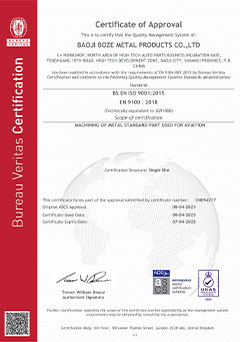
AS9100-certified BOZE CNC Ti


