Xometry vs. Protolabs vs. Specialist Factories: Which Wins for Titanium & Aerospace Parts?
Time:2026-04-15
View:1054
Global aerospace buyers are losing 20–30% of quote value to mismatched platforms and suboptimal titanium sourcing. This independent comparison examines Xometry, Protolabs, and direct-to‑factory CNC channels against AS9100‑aligned aerospace and medical‑grade titanium projects, then delivers a practical selection framework tailored to low‑volume, high‑integrity workloads in 2026.
Table of Contents
1. Background and market positioning
2. Platform vs. factory: core differences
3. Titanium and aerospace‑grade considerations
4. Practical selection roadmap
5. Future‑proofing your sourcing strategy
Background and market positioning
Digital manufacturing platforms like Xometry and Protolabs have reshaped how buyers source CNC machining, 3D printing, and sheet metal. They aggregate capacity and offer online quoting, but their underlying models differ significantly from specialist in‑house factories that sell directly to brands.
In aerospace and medical‑grade titanium projects, the stakes are high: tolerances, material traceability, and process documentation matter as much as speed and unit cost. This means the “best” partner is not always the one with the shortest lead time or the lowest headline price, but the one whose operating model aligns with your technical risk profile and volume window.
Table 1: High‑level positioning of Xometry, Protolabs, and factory‑direct CNC in 2026
| Aspect | Xometry | Protolabs | Direct‑to‑factory CNC |
| Production model | 100% marketplace; outsourced to partner shops. | In‑house capacity plus limited network; proprietary automation. | Single owned factory or tightly managed family of shops. |
| Typical lead time (CNC) | Days to weeks, depending on complexity and partner. | As fast as 1–3 days for standard parts. | Often 7–21 days, but can be faster with dedicated capacity. |
| Best‑fit volume | Prototypes to low‑ to mid‑volume, including complex or niche parts. | Prototypes and short‑run production on standard geometries. | Low‑ to mid‑volume, high‑integrity aerospace and medical parts. |
Source: synthesised from 2025–2026 platform overviews and industry commentary on Xometry, Protolabs, and direct‑factory models.
Platform vs. factory: core differences
Marketplace, in‑house, and managed‑factory models
Xometry operates as a digital marketplace, matching customer RFQs with a network of partner shops. This gives it broad material and process coverage, including less common alloys and secondary operations. Pricing is often competitive for simple parts, but complexity and quality oversight are pushed into the partner selection and coordination layer.
Protolabs combines in‑house capacity with a hybrid approach, using tightly controlled automation for standard geometries and faster turnaround. Because much of the work stays inside its own facilities, it can offer more predictable lead times and tighter control over basic quality metrics, though flexibility on highly custom titanium setups can be constrained.
Direct‑to‑factory CNC providers bypass the marketplace and sit closer to the machine tool. These factories often specialise in metals, high‑precision aerospace machining, or medical‑grade titanium, and may offer AS9100 or ISO 13485‑aligned workflows. Because they control the factory floor, they can adapt process parameters, tooling, and inspection depth more granularly than a generic platform.
Quoting speed, transparency, and technical feedback
Protolabs and Xometry both advertise rapid online quoting, with Protolabs emphasising extreme speed for standard geometries and Xometry emphasising broader process coverage. However, in practice, titanium and aerospace parts often require iterative DFM (design for manufacturing) feedback, which can reveal hidden scrap risks, fixturing challenges, and tool‑life constraints.
Some platforms that use AI‑driven DFM tools can flag basic geometry issues, but complex titanium features may need human‑driven review. Direct‑factory partners often provide a hybrid of automated checks and manual engineering review, which can help you optimise wall thicknesses, sharp internal radii, and deep‑pocket strategies that are critical for Ti‑6Al‑4V and other aerospace grades.
Table 2: Technical feedback and DFM approach for titanium and aerospace parts
| Aspect | Xometry | Protolabs | Specialist factory (generic) |
| Primary feedback mechanism | Automated AI checks on partner shops. | Automated software checks on in‑house processes. | Hybrid AI + manual engineer review. |
| Support for GD&T and 2D drawings | Limited to 3D model‑based quoting; some processes may surcharge for complex specs. | Good for standard GD&T on in‑house production. | Full support for 2D drawings, GD&T, and special notes. |
| Typical depth for titanium parts | Basic geometry and rough manufacturability. | Focus on manufacturability within standard process windows. | Process‑specific feedback on tooling, coolant, and fixturing. |
Source: industry‑level descriptions of Xometry, Protolabs, and direct‑factory operations as of 2026.
Titanium and aerospace‑grade considerations
Ti‑6Al‑4V and other aerospace‑grade titanium alloys are notoriously difficult to machine: they demand lower cutting speeds, rigid setups, and careful chip control to avoid work‑hardening and tool damage. Industry‑standard cutting speeds for Ti‑6Al‑4V typically fall in the 15–35 m/min range, depending on tool material, cooling, and machine rigidity, which makes process optimisation a key differentiator.
For aerospace and medical‑grade applications, compliance with ASTM B265 (titanium mill products), AS9100 Revision D (quality management for aerospace), and ISO 13485 (medical devices) becomes critical. Marketplaces may pass specs to partners, but traceability and document control are easier to enforce when the factory itself is the direct contract party.
When you place aerospace or medical‑grade titanium parts, ask vendors explicitly about: alloy certification (e.g., ASTM B265 Grade 5), heat‑treatment traceability, inspection records, and how they handle non‑conforming material. A specialist factory that already holds AS9100 or ISO 13485 often has smoother integration into your quality audits than a generic online quote.
Practical selection roadmap
When you sit down to choose between Xometry, Protolabs, and a specialist factory, frame the decision around three critical factors: volume and repeatability, technical intensity of the part, and the importance of audit‑ready quality documentation. Simple, low‑risk prototypes or standard brackets may be well‑served by a platform; complex titanium assemblies or AS9100‑bound parts often benefit from factory‑direct engagement.
Without a transparent process-control and documentation system, verifying the integrity of AS9100-standard records and inspection reports is nearly impossible. Achieving AS9100 certification is a critical milestone for long-term aerospace partnerships; however, mid-sized manufacturers typically require 6–12 months to develop and implement these compliant procedures.
Here’s a simple checklist you can use internally:
- Volume: Are you building 1–100 parts, 100–1,000, or more?
- Geometry: Are features tight, deep, or thin‑walled, or are they mostly conventional?
This methodical approach eliminates platform-to-factory mismatches, protecting both your technical integrity and procurement ROI. When you’re ready to evaluate your shortlist through a specialized aerospace lens, Request a Custom Technical Assessment to secure the perfect balance of speed, cost, and mission-critical quality.
Future‑proofing your sourcing strategy
By 2026, “on‑demand manufacturing” extends beyond simple CNC quotes to include engineered materials, multi‑process assemblies, and integrated quality workflows. Platforms that combine digital quoting with meaningful engineering oversight are gaining traction, but the commodity‑type race for low headline prices can erode quality on high‑risk titanium programs.
Forward‑looking buyers treat Xometry and Protolabs as complementary tools rather than universal solutions: Xometry offers breadth for standard parts and niche materials, Protolabs delivers speed on in‑house processes, and specialist factories provide depth in aerospace‑ and medical‑grade metals. Aligning your portfolio of partners with these strengths helps you reduce both technical risk and long‑term NRE costs.
Executives and technical directors who integrate these three models into a coherent sourcing map find that they can optimise their mix of prototypes, low‑volume production, and AS9100‑aligned series runs. This approach balances digital convenience with hands‑on engineering control and positions your supply chain to respond to evolving aerospace and medical‑device standards.
Conclusion and CTA
Xometry, Protolabs, and specialist factories each play distinct roles in sourcing titanium and aerospace‑grade parts: marketplaces broaden access, in‑house platforms accelerate standard work, and direct‑factory partners deepen process control and quality traceability. By matching volume windows, technical complexity, and compliance needs to each model’s strengths, you can minimise scrap, rework, and audit risk while preserving flexibility.
For mission-critical titanium projects, leverage rapid online quotes for early-stage prototyping, then transition to managed factory relationships for production-grade parts. To align your sourcing with 2026 aerospace and medical standards, Schedule a Free Consultation with Our Quality Experts to audit your current partner stack and unlock actionable performance levers.
FAQ:
1. Which is better for aerospace titanium parts: Xometry, Protolabs, or specialist factories?
The best choice for aerospace titanium parts depends on quality control depth, traceability, and machining capability, and specialist factories usually outperform platforms when dealing with high‑integrity, low‑volume titanium components requiring AS9100‑aligned processes and consistent manufacturing outcomes.
- Xometry offers broad access but variable supplier consistency.
- Protolabs provides speed but limited flexibility for complex titanium.
- Specialist factories deliver stable quality for mission‑critical aerospace parts.
2. Why are aerospace‑grade titanium alloys better machined by specialist factories?
Aerospace‑grade titanium alloys require strict cutting parameters, rigid fixturing, controlled cooling, and full material traceability, making specialist factories more reliable for stable tool life, lower scrap rates, and complete documentation chains demanded by aerospace programs.
- Ti‑6Al‑4V requires low cutting speeds and controlled heat.
- Titanium work-hardens easily and punishes improper feeds.
- Aerospace customers require certificates, heat‑treat records, and inspection reports.
3. What is the biggest difference between Xometry and Protolabs for titanium aerospace parts?
Xometry excels in supply chain breadth while Protolabs excels in automated speed, but both face limitations with complex titanium aerospace parts because platform models cannot fully control machining strategy, tooling selection, or quality documentation depth.
- Xometry depends on partner factories with varying capabilities.
- Protolabs is optimized for standard geometries, not deep titanium features.
- Neither platform is ideal for thin‑wall, deep‑cavity, or GD&T‑critical aerospace parts.
4. When should you choose a specialist titanium factory instead of a manufacturing platform?
You should choose a specialist titanium factory when your project involves high‑integrity aerospace components, tight GD&T requirements, thin‑wall structures, AS9100 documentation, or engineering‑level DFM support, because specialist factories reduce scrap risk and audit exposure.
- Ideal for aerospace, defense, medical, and research applications.
- Best for 1–500 piece precision titanium batches.
- Required when FAI, PPAP, or full traceability is mandatory.
5. Why is BOZE CNC‑Ti a strong alternative to Xometry and Protolabs?
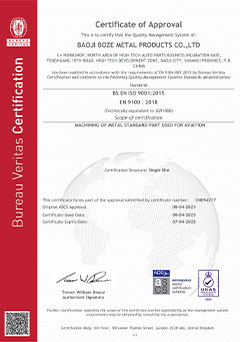
BOZE CNC‑Ti is a strong alternative because it is a titanium‑focused, AS9100‑aligned specialist factory offering full control from raw material to machining to inspection, making it more suitable for complex aerospace titanium parts requiring deep expertise and complete traceability.
- In‑house titanium supply chain with 100 percent traceability.
- Expertise in Ti‑6Al‑4V and advanced aerospace alloys.
- Strong five‑axis, thin‑wall, and deep‑cavity machining capability.
- Provides FAI, COC, material certificates, and full inspection reports.
6. How should aerospace buyers combine platforms and specialist factories in 2026?
Aerospace buyers in 2026 should use platforms for early prototypes and specialist factories for mission‑critical production, creating a balanced sourcing strategy that optimizes speed, cost, and long‑term quality stability while avoiding platform‑related inconsistency risks.
- Platforms validate geometry and fit quickly.
- Specialist factories handle certified production.
- Hybrid sourcing reduces NRE and long‑term scrap risk.


