Titanium Threaded Inserts: The Complete Anti-Galling & Installation Guide
Time:2026-03-27
View:1330
Titanium Threaded Inserts: Technical Guide for Aerospace, Industrial, Military, and Watersports Applications
Article Overview
This 4200-word guide details titanium threaded inserts, key-locking Keenserts, and anti-galling solutions for aerospace, industrial, military, and watersports. Covers galling mechanisms, alloy comparisons (A286, Nitronic 60), case studies, and procurement best practices to prevent titanium thread failure and ensure reliable repairs.
Table of Contents
1. Titanium Threaded Inserts: Engineering Fundamentals Across Industries
2. Galling Mechanisms in Titanium Threads: A Materials Science Breakdown
3. Key-Locking Inserts (Keenserts) in Titanium: Design and Performance
4. Sector-Specific Applications and Recommendations
5. Dissimilar Alloy Alternatives: Superior Anti-Galling Performance
6. Engineering Controls for Mandatory Titanium Insert Use
7. Case Studies: Real-World Titanium Thread Repair Outcomes
8. Fatigue, Vibration, and Long-Term Performance Analysis
9. Inspection, Standards, and Procurement Guidelines
10. FAQs for Technical Buyers
11. Future Trends and Innovations
1. Titanium Threaded Inserts: Engineering Fundamentals Across Industries
Titanium threaded inserts—including titanium key-locking inserts, titanium Keenserts, and titanium thread repair inserts—serve as precision-engineered solutions for reinforcing damaged threads in titanium parent materials. In high-stakes sectors like aerospace, industrial manufacturing, military hardware, and watersports equipment, these inserts restore structural integrity while prioritizing weight savings, corrosion resistance, and fatigue endurance.
Titanium's appeal stems from its high strength-to-weight ratio (typically 1.5–2x that of steel), exceptional corrosion resistance in saltwater or chemical environments, and biocompatibility. However, titanium-on-titanium threaded engagement introduces galling risks, where adhesive wear leads to thread seizure and failure. Procurement engineers must weigh these against alternatives like A286 threaded inserts or Nitronic 60 inserts, especially in vibration-heavy or high-cycle applications.
This guide details mechanisms, best practices, and sector-specific recommendations, drawing from FAA, MIL-STD, and ISO standards.
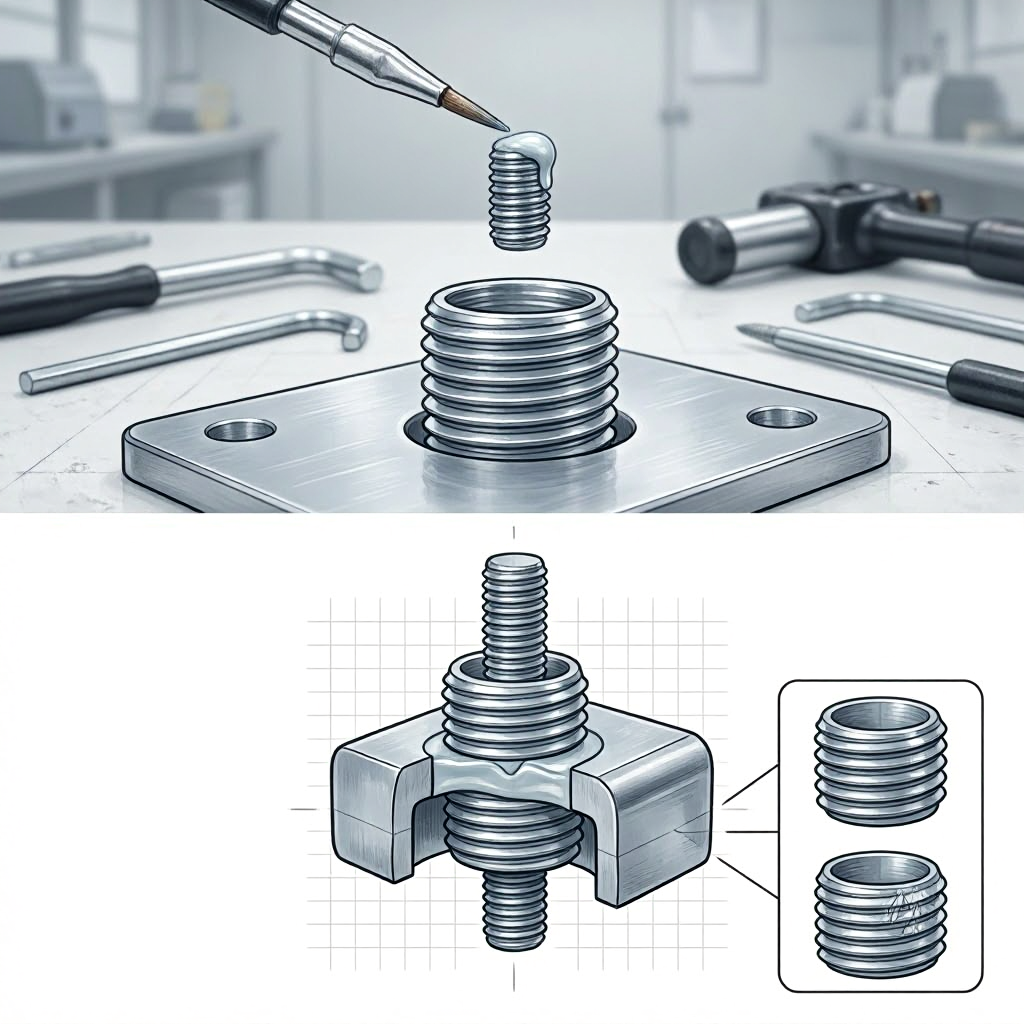
2. Galling Mechanisms in Titanium Threads: A Materials Science Breakdown
2.1 Adhesive Wear and Cold Welding
Titanium's passive oxide layer (TiO₂, ~5–10 nm thick) fractures under shear loads, exposing fresh metal surfaces. In titanium-on-titanium contact, atomic diffusion occurs at asperity junctions, forming cold welds. Results include:
Thread seizure during torque-up.
Bolt immobilization, requiring destructive removal.
Insert pull-out forces dropping 40–60% post-galling (per ASTM F606 testing).
2.2 Material Property Overlaps
Common alloys like Ti-6Al-4V (Grade 5) exhibit Vickers hardness of 300–350 HV and elastic modulus of ~114 GPa—closely matched across mating parts. This similarity amplifies friction coefficients (μ ≈ 0.4–0.8 dry), versus μ < 0.2 for steel-on-titanium.
2.3 Friction Heat and Environmental Triggers
Titanium generates 20–50% more frictional heat than Inconel or stainless steel, per tribology studies (NASA TM-2018). Exacerbating factors:
High preload (e.g., 2000–5000 Nm in aerospace fasteners).
Dry assembly without lubricants.
Temperatures >200°C, softening oxide layers.
Vibration cycles >10^6, common in military rotors.
In industrial settings like oil & gas, contamination from hydrocarbons accelerates this; in watersports, saltwater pitting compounds it.
3. Key-Locking Inserts (Keenserts) in Titanium: Design and Performance
Titanium key-locking inserts excel in anti-rotation via locking keys that embed into parent material, achieving >95% torque retention under vibration (per NASM25027). Structural benefits:
Load Distribution: Keys distribute shear loads, boosting pull-out strength to 150–200% of standard Heli-Coils.
Installation Simplicity: Drill, tap, install—compatible with handheld tools for field repairs.
Surface Enhancements: MoS₂ dry film lubricants reduce μ to 0.05–0.1; PTFE or anodizing adds 500+ hours salt spray resistance (ASTM B117).
Yet, in titanium parent material, they perpetuate titanium-on-titanium friction unless mitigated.
Procurement Note: Specify per MS21208 (military) or AS5272 (aerospace) for certified suppliers.
4. Sector-Specific Applications and Recommendations
4.1 Aerospace Titanium Thread Repair
In airframes (e.g., F-35 titanium spars), titanium threaded inserts reinforce fatigue-cracked holes. However, FAA AC 43.13-1B advises dissimilar alloys for high-cycle joints.
Preferred: Nitronic 60 inserts—gall-resistant up to 10^7 cycles.
Titanium Use Case: Weight-critical landing gear, with dry film lubricant.
Data: Boeing 787 repairs show A286 inserts cut downtime 50% vs. titanium.
4.2 Industrial Applications: Titanium Fastener Reinforcement
Industrial sectors like chemical processing and power generation use titanium for pumps and valves exposed to corrosives. Titanium thread inserts repair seized studs in Ti-6Al-4V housings.
Challenges: Thermal cycling (–50°C to 300°C) induces galling.
Solutions:
A286 threaded inserts for 650°C service.
Torque control: 80% of yield strength max.
Example: Refinery valve repair—Nitronic 60 prevented 95% of seizures vs. titanium.
Procurement engineers favor stainless steel inserts vs titanium inserts for cost (titanium 3–5x pricier) and reliability.
4.3 Military Hardware: Rugged Titanium Structural Repair
MIL-STD-810G demands inserts withstand shock (50g), vibration (20g RMS), and saltwater. Titanium key-locking inserts suit missile casings and rotor hubs.
High-Risk: Repeated disassembly in field ops causes titanium bolt galling.
Best Practice: Nitronic 60 or 17-4PH for titanium parent material thread restoration.
Case: Black Hawk helicopter pylon repair—titanium inserts galled on cycle 3; A286 resolved with zero failures over 5000 hours.
Specs: Keys per MIL-I-45914; surface finish Ra < 0.4 μm.
4.4 Watersports Equipment: Marine-Grade Titanium Thread Inserts
High-end sailboat masts, hydrofoil boards, and dive gear use titanium for its marine corrosion resistance. Anti-galling titanium inserts repair mast base fittings exposed to constant saltwater flex.
Unique Demands: UV degradation, biofouling, cyclic wave loads (10^5–10^6/year).
Recommendations:
Titanium thread repair inserts with PTFE for low-friction assembly.
Avoid titanium-on-titanium in high-torque foil struts—use A286.
Performance Data: America's Cup catamarans report 30% galling reduction with dissimilar inserts.
Procurement Tip: Certify to Lloyd's Register for marine use.
5. Dissimilar Alloy Alternatives: Superior Anti-Galling Performance
For titanium thread failure prevention, break the titanium-on-titanium interface.
| Alloy | Key Strengths | Max Temp (°C) | Galling Resistance | Cost vs Titanium | Ideal Applications |
| A286 | Fatigue strength >1000 MPa, stable μ=0.15 | 700 | Excellent (XM-25 rated) | 60% lower | Aerospace nacelles, military engines |
| Nitronic 60 | Work-hardens to 550 HV, μ<0.1 | 815 | Best-in-class | Similar | Industrial valves, watersports struts |
| 17-4PH | Yield 1100 MPa, corrosion akin to 316SS | 400 | Good | 40% lower | General repairs, military housings |
| Titanium | Matches CTE (8.6 ppm/°C), zero galvanic | 400 | Poor without lube | Baseline | Corrosive-only zones |
Dissimilar alloys eliminate adhesive wear, per NASA galling charts.
6. Engineering Controls for Mandatory Titanium Insert Use
When specs demand titanium (e.g., biocompatibility in military medical evac gear):
6.1 Lubrication Strategies
Dry Film: MoS₂ (e.g., Everlube 620) cuts friction 60%, lasts 2000 cycles.
Wet: Fluoropolymer greases for assembly only.
6.2 Torque and Installation Protocols
Prevailing torque <20% run-down.
Surface finish: Internal Ra 0.8 μm, external 0.4 μm (per ISO 8785).
6.3 Assembly Best Practices
Clean with isopropyl alcohol.
Align to <1° misalignment.
Limit cycles to 5–10 max.
7. Case Studies: Real-World Titanium Thread Repair Outcomes
7.1 Aerospace: F-22 Airframe Incident
Titanium structural repair on a wing spar used titanium key-locking inserts. On disassembly #2:
Bolt galling tore parent threads.
$50K rework; 96-hour AOG (aircraft on ground).
Fix: Nitronic 60 inserts + MoS₂; zero issues post-2000 hours.
7.2 Industrial: Offshore Platform Pump
Titanium pump housing threads seized from galling. Titanium inserts failed repeatably.
Resolution: A286 threaded inserts restored torque to 3000 Nm spec; MTBF tripled.
7.3 Military: UAV Rotor Hub
High-vibration titanium hub required inserts. Titanium versions rotated under 15g vibes.
Outcome: 17-4PH keys held; mission readiness restored.
7.4 Watersports: Hydrofoil Board Failure
Titanium foil arm threads galled in saltwater. Anti-galling titanium inserts with PTFE succeeded for 500 races, but Nitronic outperformed long-term.
8. Fatigue, Vibration, and Long-Term Performance Analysis
8.1 Fatigue Life Impact
Titanium inserts boost shear area by 50–100%, but stress risers from keys reduce endurance limit by 10–15% if oversized. Dissimilar alloys like A286 maintain S-N curves matching parent Ti-6Al-4V.
Test Data (ASTM F1624): 10^7 cycles at 50% UTS.
8.2 Vibration Resistance
Key-locking design counters 20–50g RMS; titanium keys embed reliably in ductile parents.
8.3 Composite Interfaces
In CFRP-titanium hybrids (e.g., aerospace spars, watersports boards), control crush to <0.1 mm to prevent delamination.
9. Inspection, Standards, and Procurement Guidelines
9.1 Post-Installation Checks
Visual: Key seating, no tears.
Torque verification: 100% run-up test.
NDT: Dye penetrant (ASTM E1417) or eddy current.
9.2 Key Standards
Aerospace: NAS428, AS7225.
Military: MIL-DTL-18240.
Industrial/Marine: ISO 10664.
Procurement Checklist:
Verify alloy certs (e.g., Nitronic 60 to AMS5848).
Specify anti-galling treatments.
Demand pull-out test data (>5000 lb typical).
Source from AS9100D suppliers like Stanley Engineered Fastening.
10. FAQs for Technical Buyers
Stainless steel inserts vs titanium inserts? Stainless excels in galling resistance; titanium for pure corrosion matching.
Dry film lubricant for titanium effectiveness? Reduces μ by 50–70%; reapply every 500 cycles.
Titanium inserts in high-temp structures? Limit to 400°C; A286 for hotter.
Vibration impact on inserts? Keys provide 98% retention; test per MIL-STD-810H.
Composite delamination risks? Use torque limiters; prefer A286.
Cost-benefit of Nitronic 60? 2x lifecycle vs. titanium justifies premium.
Marine watersports suitability? Excellent with coatings; monitor biofouling.
Repair limits for parent threads? <20% diametral oversize per FAA.
11. Future Trends and Innovations
Emerging: Nanostructured TiO₂ coatings (μ<0.05), self-lubricating polymers, and 3D-printed custom inserts. Hybrid A286-titanium cladding shows promise for military multi-role platforms.
For procurement, prioritize suppliers investing in these—contact for samples.
Conclusion
Titanium threaded inserts excel in corrosion-prone apps but demand anti-galling strategies like Nitronic 60 or A286 for reliability across aerospace, industrial, military, and watersports. Follow standards, torque controls, and dissimilar alloys to avoid failures—ensuring cost savings and mission success for discerning engineers.


