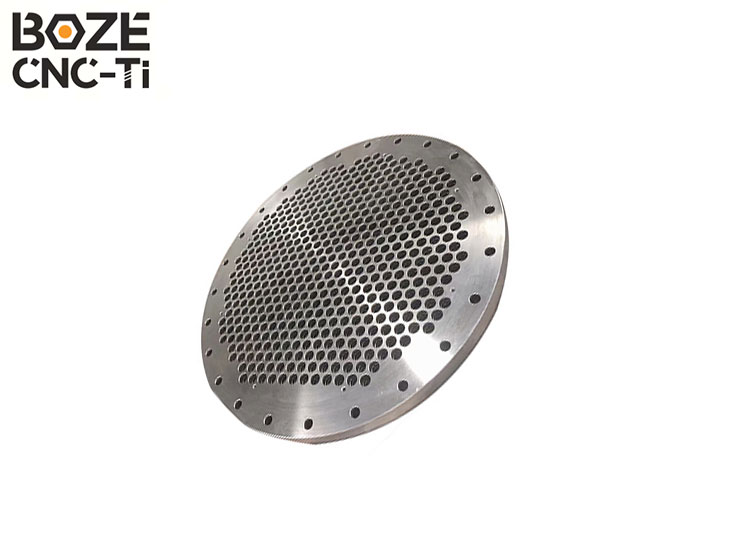
A titanium tube sheet is a critical component in high-performance heat exchangers, acting as the structural "grid" that holds the heat transfer tubes in place and separates the shell-side and tube-side fluids.
Because titanium offers an exceptional strength-to-weight ratio and near-total immunity to corrosion in saltwater and chlorides, these plates are the gold standard for marine, chemical processing, and power generation applications.
Material Grades
Depending on fluid properties and pressure levels, the following titanium materials are usually selected:
Grade 2 (industrial pure titanium): the most commonly used specification. Excellent corrosion resistance and good processability, suitable for most seawater, chloride and organic acid environment.
Grade 7 (titanium Palladium alloy): Palladium is added on the basis of Grade 2, mainly for strong acid or reducing environment (such as dilute sulfuric acid, dilute hydrochloric acid).
Grade 12 (titanium molybdenum nickel alloy): specifications for high temperature, high pressure environment, and has a strong resistance to crevice corrosion.
Grade 5 (Ti-6Al-4V): Only for special structural parts with extremely high strength requirements.
Technical Specifications
| Feature | Common Standard / Detail |
| Common Grades | Grade 2 (Unalloyed), Grade 5 (Ti-6Al-4V), Grade 7 (Palladium enhanced) |
| Design Codes | ASME Section VIII, TEMA (Tubular Exchanger Manufacturers Association) |
| Hole Patterns | Triangular (better heat transfer) or Square (easier cleaning) |
| Joining Method | Strength welding, Seal welding, or Roller expansion |
Manufacturing Methods
Titanium tube sheets are typically produced in one of two ways depending on the budget and pressure requirements:
1. Solid Titanium
The entire plate is machined from a solid titanium forging or plate (typically Grade 2 for general corrosion or Grade 7/12 for high-temp/low pH).
2. Titanium Clad (Explosion Bonded)
A thin layer of titanium (the "cladding") is bonded to a thicker, cheaper backing material like Carbon Steel or Stainless Steel. This is usually done via Explosion Welding.
Why Use Titanium?
While more expensive than carbon steel or stainless steel, titanium is chosen when "failure is not an option."
Corrosion Resistance: Virtually immune to localized attack and stress corrosion cracking in brackish or seawater.
Weight Efficiency: Roughly 45% lighter than steel with comparable strength.
Thermal Expansion: Titanium has a lower coefficient of thermal expansion than many metals, which helps reduce thermal fatigue at the tube-to-tube sheet joint.
Longevity: In aggressive environments, a titanium tube sheet can outlast stainless steel alternatives by decades, lowering the "Total Cost of Ownership."
Key Challenges
Galling: Titanium is prone to galling during the tube expansion process. Precision machining and lubrication are required to prevent damage to the holes.
Welding Atmosphere: Titanium is highly reactive. All welding (Tube-to-Tube Sheet joints) must be done in a high-purity inert gas (Argon) environment to prevent embrittlement.
Galvanic Corrosion: If using a clad tube sheet, the interface between the titanium and the backing metal must be perfectly sealed to prevent "crevice corrosion" at the bond line.